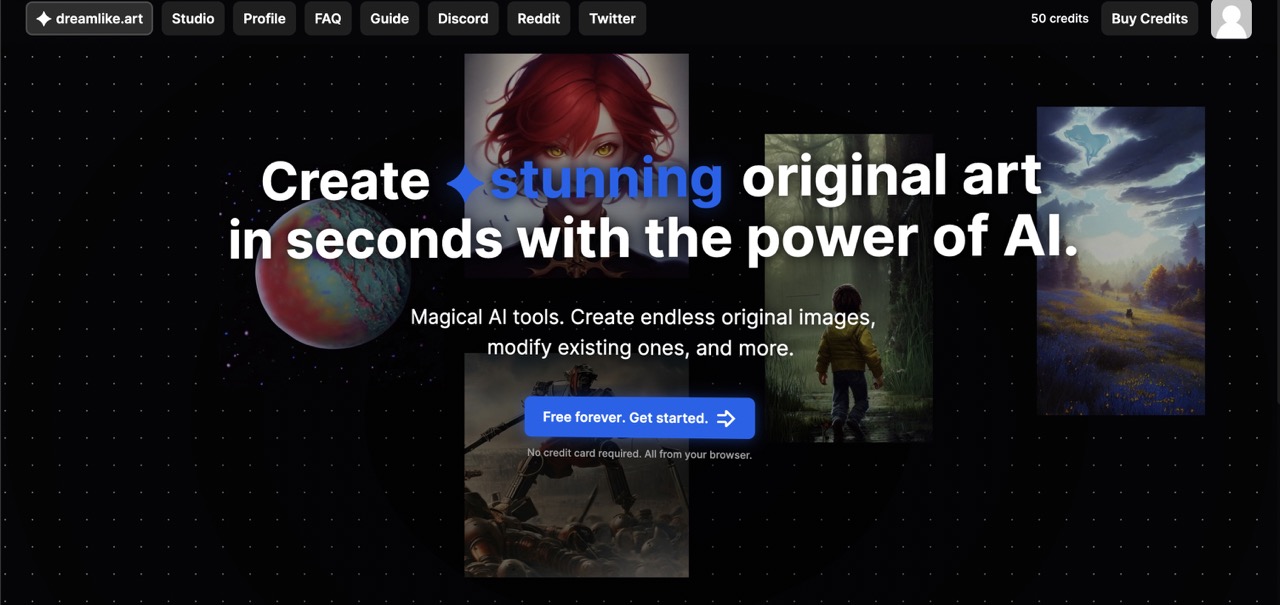
In the world of digital art, the boundaries of imagination are constantly being pushed with new tools and technologies. One such tool is the free AI image generation site, Dreamlike.art. With its advanced algorithms and deep learning capabilities, Dreamlike.art is changing the way artists and graphic designers create unique, visually stunning images.
Dreamlike.art is a user-friendly platform that allows you to generate high-quality images with just a few clicks. You don’t need any special skills or knowledge to use it – simply choose a style and start creating. The site offers a wide range of styles to choose from, including abstract, landscapes, portraits, and more. You can also control the level of detail and complexity of the images you generate.
One of the standout features of Dreamlike.art is the speed at which it generates images. In just a few seconds, you can have a unique, high-quality image that is ready to be used for your projects. This makes the platform ideal for artists and designers who are working on tight deadlines and need to create images quickly.
Another great feature of Dreamlike.art is that it is completely free to use. You don’t need to pay for any subscriptions or licenses to generate images, making it accessible to everyone, regardless of budget. This makes it a great option for small businesses, freelancers, and hobbyists who want to create visually stunning images without breaking the bank.
In conclusion, Dreamlike.art is a game-changer in the world of digital art. With its advanced AI technology and user-friendly interface, it is making it easier than ever before to create unique, high-quality images. Whether you’re a seasoned professional or just starting out, Dreamlike.art is the perfect platform for you to unleash your creativity and bring your visions to life. So why not give it a try today and see what you can create!
The Power of Video Generation: The Story Behind Linkin Park’s “Lost” Music Video Linkin Park, one of the biggest names in the music industry, recently released the music video for their single “Lost” and it quickly gained widespread attention, receiving over 4.9 million views in just one day. The music video is a visual representation of the emotion and energy that the song embodies, and it’s no surprise that it has been such a hit with fans. What many people don’t know is that the music video for “Lost” was created using video generation technology by Kaiber.ai. This cutting-edge AI-powered tool allowed the production team to bring their vision to life in a way that was both fast and efficient. With Kaiber.ai, the production team was able to generate a series of 3D animations that were combined with live-action footage to create the final product. The result was a stunning visual representation of the song’s emotion and energy, perfectly capturing the essence of Linkin Park’s music. The transitions between the live-action footage and 3D animations were smooth and fluid, creating a seamless visual experience for the viewer. The intricate animations, including a pulsing energy field and dynamic, flowing patterns, were created using Kaiber.ai’s powerful animation tools, making it possible to create complex animations with ease. In conclusion, the success of Linkin Park’s “Lost” music video is a testament to the power of video generation technology and the incredible things that can be achieved with tools like Kaiber.ai. With its intuitive interface and powerful features, Kaiber.ai makes it possible for anyone to create professional-looking videos that captivate and engage their audience. Whether you’re a seasoned video creator or just starting out, Kaiber.ai is the perfect tool for bringing your imagination to life. LostMusicVideo, LinkinPark, VideoGeneration, Kaiberai, MusicVideoProduction, AIpowered, IntuitiveVideoCreation, EmotionAndEnergy, #stunningvisuals
Linkin Park, one of the biggest names in the music industry, recently released the music video for their single “Lost” and it quickly gained widespread attention, receiving over 4.9 million views in just one day. The music video is a visual representation of the emotion and energy that the song embodies, and it’s no surprise that it has been such a hit with fans.
What many people don’t know is that the music video for “Lost” was created using video generation technology by Kaiber.ai. This cutting-edge AI-powered tool allowed the production team to bring their vision to life in a way that was both fast and efficient.
With Kaiber.ai, the production team was able to generate a series of 3D animations that were combined with live-action footage to create the final product. The result was a stunning visual representation of the song’s emotion and energy, perfectly capturing the essence of Linkin Park’s music.
The transitions between the live-action footage and 3D animations were smooth and fluid, creating a seamless visual experience for the viewer. The intricate animations, including a pulsing energy field and dynamic, flowing patterns, were created using Kaiber.ai’s powerful animation tools, making it possible to create complex animations with ease.
In conclusion, the success of Linkin Park’s “Lost” music video is a testament to the power of video generation technology and the incredible things that can be achieved with tools like Kaiber.ai. With its intuitive interface and powerful features, Kaiber.ai makes it possible for anyone to create professional-looking videos that captivate and engage their audience. Whether you’re a seasoned video creator or just starting out, Kaiber.ai is the perfect tool for bringing your imagination to life.
Music is a universal language that has the power to bring people together and evoke a wide range of emotions. However, understanding the language of music and the creative process behind it can be a complex and mysterious endeavor. Fortunately, advancements in artificial intelligence and machine learning have made it possible to unlock the secrets of music and gain new insights into how it is created and understood.
Google has recently introduced SEANET and MusicLM, two powerful tools that allow researchers and music enthusiasts to explore the musical language in new and exciting ways. SEANET, short for “Structured Event Network”, is a neural network that is able to analyze the structure and harmony of music. MusicLM, on the other hand, is a language model that is trained on a dataset of thousands of songs and can generate new music that is similar to existing songs.
One of the most exciting features of SEANET is its ability to analyze the structure and harmony of music in real-time. This allows researchers to study how different sections of a song are related to one another and how the harmonic progression evolves over time. Additionally, SEANET can be used to study the relationship between different sections of a song and how they are related to one another.
MusicLM is a powerful tool that allows researchers to generate new music that is similar to existing songs. The model is trained on a dataset of thousands of songs and can generate new songs that are similar in style, structure, and harmony. By adjusting the parameters of the model, researchers can fine-tune the generated songs to match the style and structure of a specific song or genre.
One of the most exciting applications of MusicLM is its ability to generate new songs that are similar to existing songs. This can be used to create new music for films, video games, and other media. Additionally, MusicLM can be used to generate new music for live performances, allowing musicians to experiment with new sounds and styles in real-time.
Overall, SEANET and MusicLM are powerful tools that allow researchers and music enthusiasts to explore the musical language in new and exciting ways. By unlocking the secrets of music, these tools can help us gain new insights into how music is created and understood, and ultimately, how it can bring people together.
Google, known for its search engine, is reportedly concerned about the impact of OpenAI’s ChatGPT, a Q&A machine that uses natural language to respond to questions. ChatGPT’s user-friendly interface and fluid prose has led to speculation that it may end Google’s dominance in search. In response, Google has declared a “code red” and is focusing on AI with plans to release 20 AI-powered products this year, including a ChatGPT-like search bot. However, questions remain about the technology’s readiness for widespread use and whether it can be trusted for accurate information.
Google is one of the biggest companies on Earth. Google’s search engine is the front door to the internet. And according to recent reports, Google is scrambling. Late last year, OpenAI, an artificial intelligence company at the forefront of the field, released ChatGPT. Alongside Elon Musk’s Twitter acquisition and fallout from FTX’s crypto implosion, breathless chatter about ChatGPT and generative AI has been ubiquitous. The chatbot, which was born from an upgrade to OpenAI’s GPT-3 algorithm, is like a futuristic Q&A machine. Ask any question, and it responds in plain language. Sometimes it gets the facts straight. Sometimes not so much. Still, ChatGPT took the world by storm thanks to the fluidity of its prose, its simple interface, and a mainstream launch.
When a new technology hits public consciousness, people try to sort out its impact. Between debates about how bots like ChatGPT will impact everything from academics to journalism, not a few folks have suggested ChatGPT may end Google’s reign in search. Who wants to hunt down information fragmented across a list of web pages when you could get a coherent, seemingly authoritative, answer in an instant?
In December, The New York Times reported Google was taking the prospect seriously, with management declaring a “code red” internally. This week, as Google announced layoffs, CEO Sundar Pichai told employees the company will sharpen its focus on AI. The NYT also reported Google founders, Larry Page and Sergey Brin, are now involved in efforts to streamline development of AI products. The worry is that they’ve lost a step to the competition.
If true, it isn’t due to a lack of ability or vision. Google’s no slouch at AI. The technology here—a flavor of deep learning model called a transformer—was developed at Google in 2017. The company already has its own versions of all the flashy generative AI models, from images (Imagen) to text (LaMDA). Indeed, in 2021, Google researchers published a paper pondering how large language models (like ChatGPT) might radically upend search in the future. “What if we got rid of the notion of the index altogether and replaced it with a pre-trained model that efficiently and effectively encodes all of the information contained in the corpus?” Donald Metzler, a Google researcher, and coauthors wrote at the time. “What if the distinction between retrieval and ranking went away and instead there was a single response generation phase?” This should sound familiar.
Whereas smaller organizations opened access to their algorithms more aggressively, however, Google largely kept its work under wraps. Offering only small, tightly controlled demos to limited groups of people, it deemed the tech too risky and error-prone for wider release just yet. Damage to its brand and reputation was a chief concern.
Chat GPT Chat with AI Artificial Intelligence. Businessman using chatbot in computer smart intelligence Ai, artificial intelligence developed by OpenAI. Futuristic technology, robot in online system.
Now, sweating it out under the bright lights of ChatGPT, the company is planning to release some 20 AI-powered products later thisyear, according to the NYT. These will encompass all the top generative AI applications, like image, text, and code generation—and they’ll test a ChatGPT-like bot in search. But is the technology ready to go from splashy demo tested by millions to a crucial tool trusted by billions? In their 2021 paper, the Google researchers suggested an ideal chatbot search assistant would be authoritative, transparent, unbiased, accessible, and contain diverse perspectives. Acing each of those categories is still a stretch for even the most advanced large language models. Trust matters with search in particular. When it serves up a list of web pages today, Google can blame content creators for poor quality and vow to serve better results in the future. With an AI chatbot, it is the content creator, and if ChatGPT can’t get its facts straight, it may not be able to gain the trust of users, ultimately leading to its failure.