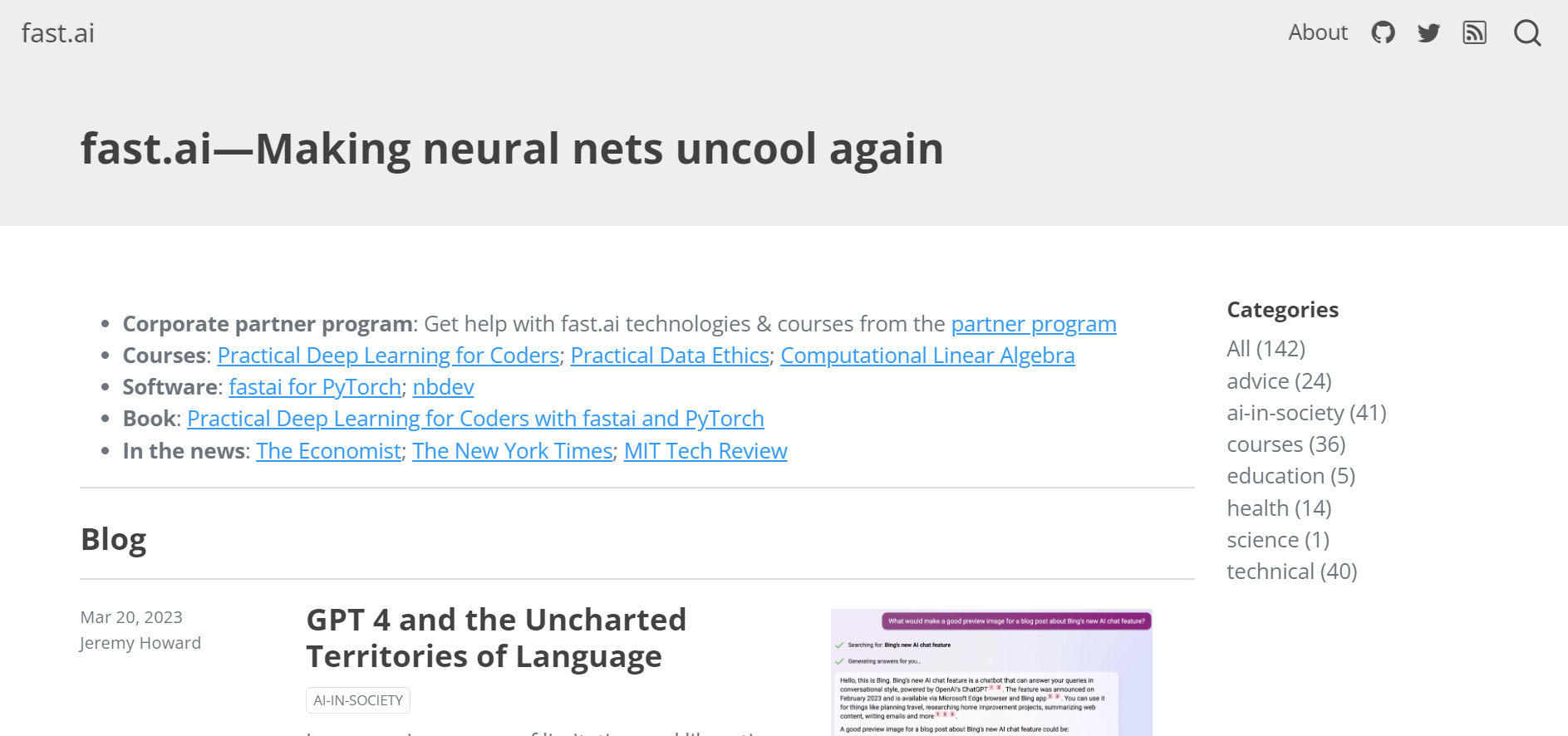
Are you interested in learning about artificial intelligence and deep learning? Look no further than Fast.ai. This non-profit research group is dedicated to making AI accessible to everyone, with a range of courses, research, and software tools available on their website.
Fast.ai’s courses are designed to be accessible and easy to understand, even for those with no prior experience in AI. They cover a range of topics, from deep learning and machine learning to natural language processing and computer vision. And with a focus on practical applications, Fast.ai’s courses help students develop the skills they need to apply AI to real-world problems.
In addition to their courses, Fast.ai also conducts cutting-edge research in the field of AI. They have developed several software tools to help researchers and developers build and deploy AI models more efficiently, including the fastai library and the fastpages blogging platform.
Overall, Fast.ai is a must-visit resource for anyone interested in learning about AI and deep learning. With their user-friendly courses, groundbreaking research, and practical software tools, Fast.ai is helping to democratize AI and make it accessible to everyone.
The field of artificial intelligence (AI) has seen incredible advancements over the past decade, and much of it can be attributed to the pioneering work of Ilya Sutskever. Sutskever is a machine learning expert and a co-founder of OpenAI, a research company dedicated to advancing AI for the betterment of humanity. His contributions to the field have been nothing short of revolutionary, and his work has laid the foundation for many of the AI breakthroughs we see today.
Early Life and Education
Ilya Sutskever was born in Russia in 1984 and later moved to Canada with his family. He attended the University of Toronto, where he obtained his bachelor’s degree in computer science. He went on to pursue a Ph.D. in machine learning at the University of Montreal, where he worked under the guidance of renowned AI researcher Yoshua Bengio.
Contributions to AI
Sutskever’s research has been instrumental in the development of deep learning, a subfield of machine learning that has been responsible for many of the recent advances in AI. In 2011, Sutskever co-authored a paper on deep learning that laid the foundation for many of the techniques used in the field today. The paper introduced the concept of deep neural networks, which are artificial neural networks with multiple layers. These networks can learn to recognize complex patterns in data, such as images, speech, and text.
One of Sutskever’s most notable contributions to AI is his work on neural machine translation. In 2014, he co-authored a paper that introduced a new approach to machine translation using deep neural networks. The approach, known as sequence to sequence (seq2seq) modeling, revolutionized machine translation by allowing systems to translate whole sentences at once, rather than just individual words. This breakthrough led to significant improvements in the quality of machine translations, and it is now widely used in many translation systems.
Sutskever has also made significant contributions to the field of reinforcement learning, a branch of AI concerned with teaching machines how to make decisions based on trial and error. In 2015, he co-authored a paper on deep reinforcement learning that introduced a technique known as asynchronous methods for deep reinforcement learning. This technique allowed multiple agents to learn from the same experience, which significantly accelerated the learning process.
OpenAI
In 2015, Sutskever co-founded OpenAI, a research company dedicated to advancing AI in a safe and beneficial way. The company’s goal is to ensure that AI technology benefits humanity as a whole, rather than just a select few. OpenAI’s research spans a wide range of areas, from natural language processing and robotics to healthcare and education.
Through OpenAI, Sutskever has continued to make significant contributions to the field of AI. In 2016, he co-authored a paper on generative adversarial networks (GANs), a type of neural network that can generate new data by learning the underlying patterns in a dataset. This breakthrough has led to many exciting applications, including the generation of realistic images and videos.
Conclusion
Ilya Sutskever’s contributions to the field of AI have been nothing short of groundbreaking. His research has laid the foundation for many of the recent breakthroughs in deep learning and has led to significant improvements in machine translation, reinforcement learning, and generative modeling. Through his work at OpenAI, Sutskever continues to push the boundaries of AI research, and his contributions will undoubtedly shape the field for years to come.
Artificial Intelligence has come a long way since its inception in the 1950s. The field has grown by leaps and bounds, and today, AI is an integral part of our lives. From self-driving cars to facial recognition technology, AI is changing the world as we know it. One person who has been at the forefront of this revolution is Yann LeCun, the Father of Deep Learning.
Born in Soisy-sous-Montmorency, France in 1960, Yann LeCun showed an early interest in mathematics and science. He received his undergraduate degree in physics from Pierre and Marie Curie University in Paris in 1983, and his Ph.D. in computer science from Pierre and Marie Curie University in 1987. After completing his Ph.D., he worked as a postdoctoral researcher at the Adaptive Systems Research Department at AT&T Bell Laboratories in New Jersey.
It was at AT&T Bell Laboratories that LeCun made his groundbreaking contribution to the field of AI. In 1989, he invented a new type of neural network called Convolutional Neural Networks (CNNs), which was designed to process visual information. CNNs have since become the backbone of many computer vision tasks, such as image classification, object detection, and facial recognition.
LeCun’s work on CNNs was not immediately recognized. At the time, neural networks were not as popular as they are today, and many researchers believed that they were not useful for practical applications. However, LeCun persevered, and his work on CNNs eventually gained recognition.
In 1996, LeCun returned to academia and became a professor at New York University. He continued to work on deep learning, and in 2013, he and his colleagues developed a new type of neural network called a Deep Convolutional Neural Network (DCNN). DCNNs were even more powerful than CNNs, and they became the basis for many new applications in computer vision, natural language processing, and speech recognition.
LeCun’s work on deep learning has earned him many accolades. He has won numerous awards, including the IEEE Neural Network Pioneer Award in 2014, the IEEE Neural Network Society’s Technical Achievement Award in 2015, and the ACM A.M. Turing Award in 2018, which is considered to be the Nobel Prize of computing.
In addition to his work on deep learning, LeCun has also been a vocal advocate for open-source software and the democratization of AI. He believes that AI should be accessible to everyone, and that it has the potential to change the world for the better.
In conclusion, Yann LeCun is a true pioneer in the field of artificial intelligence. His work on deep learning has revolutionized the field, and his contributions to computer vision, natural language processing, and speech recognition have paved the way for many new applications. LeCun’s dedication and perseverance have earned him numerous accolades, and his advocacy for open-source software and the democratization of AI make him a true visionary. Yann LeCun is a true inspiration to anyone who is interested in the field of AI, and his work will undoubtedly continue to shape the future of AI for years to come.
Deep Learning (DL) is a branch of machine learning that has revolutionized the field of artificial intelligence (AI). It involves training artificial neural networks with a large number of layers to learn complex representations of data, and has enabled breakthroughs in image recognition, speech recognition, natural language processing, and other areas.
Deep Learning has its roots in the development of artificial neural networks (ANNs) in the 1940s and 1950s, but progress was slow until the 1980s, when new algorithms and computing power allowed for larger and deeper networks to be trained. In the 2010s, the advent of powerful graphics processing units (GPUs) and large datasets enabled the training of even deeper networks, leading to the current deep learning revolution.
Deep Learning is particularly suited to tasks that involve large amounts of data, such as image and speech recognition. Convolutional neural networks (CNNs) are a type of deep learning model that is commonly used for image recognition, and have achieved remarkable results on benchmarks such as the ImageNet dataset. Recurrent neural networks (RNNs) are another type of deep learning model that is well-suited to tasks involving sequences, such as natural language processing and speech recognition.
One of the key advantages of deep learning is its ability to learn representations of data that are not hand-engineered by humans. In traditional machine learning, a human expert would typically design features that the model would use to make predictions. In deep learning, the model learns these features automatically through the training process, allowing for more flexible and robust models.
Deep Learning has been used to achieve breakthroughs in a variety of applications, including self-driving cars, medical diagnosis, and drug discovery. It has also been used to develop creative applications such as style transfer, where the style of one image is applied to another image, and generative models, which can create new images, music, and other forms of art.
Despite its successes, deep learning still faces many challenges. One of the biggest challenges is the need for large amounts of labeled data to train the models. This can be a bottleneck in applications where obtaining labeled data is difficult or expensive. Another challenge is the interpretability of deep learning models, which can be difficult to understand and debug due to their complexity.
In conclusion, Deep Learning is a powerful technique for training artificial neural networks with a large number of layers to learn complex representations of data. It has enabled breakthroughs in a variety of applications and has the potential to transform many industries. While it still faces many challenges, the rapid progress in the field suggests that deep learning will continue to have a significant impact on the future of AI.
Yoshua Bengio is a renowned computer scientist and artificial intelligence (AI) expert, widely recognized as one of the pioneers of deep learning. He is a professor at the University of Montreal and the founder and scientific director of Mila, Quebec’s AI institute.
Born in Paris, France in 1964, Bengio grew up in Montreal, Canada. He received his undergraduate degree in computer science and mathematics from McGill University in 1985, and his PhD in computer science from the Université de Montréal in 1991.
Bengio’s research interests are focused on machine learning, natural language processing, and deep learning. He is best known for his work on deep learning, which is a subfield of machine learning that focuses on the development of artificial neural networks capable of processing large amounts of data.
One of Bengio’s most significant contributions to the field of deep learning is his work on “word embeddings.” Word embeddings are a way of representing words in a high-dimensional space, where each dimension represents a different feature of the word. This technique has been used to improve the accuracy of natural language processing tasks, such as language translation and sentiment analysis.
Bengio has also made significant contributions to the development of “neural machine translation,” which is a type of machine translation that uses neural networks to translate text from one language to another. This technique has significantly improved the accuracy of machine translation, making it more useful in a variety of applications.
In addition to his research, Bengio is also a committed advocate for ethical and responsible AI. He has co-founded the International Conference on Learning Representations (ICLR), which is committed to promoting open research and promoting the development of ethical and socially responsible AI.
Bengio has received numerous awards and honors for his contributions to the field of AI, including the Turing Award, which is often referred to as the “Nobel Prize of Computing.” He has also been named an Officer of the Order of Canada and a Fellow of the Royal Society of Canada.
In conclusion, Yoshua Bengio is a world-renowned computer scientist and AI expert who has made significant contributions to the field of deep learning and natural language processing. His research has improved the accuracy and effectiveness of AI in a variety of applications, and his commitment to ethical and responsible AI has made him a leader in the field.
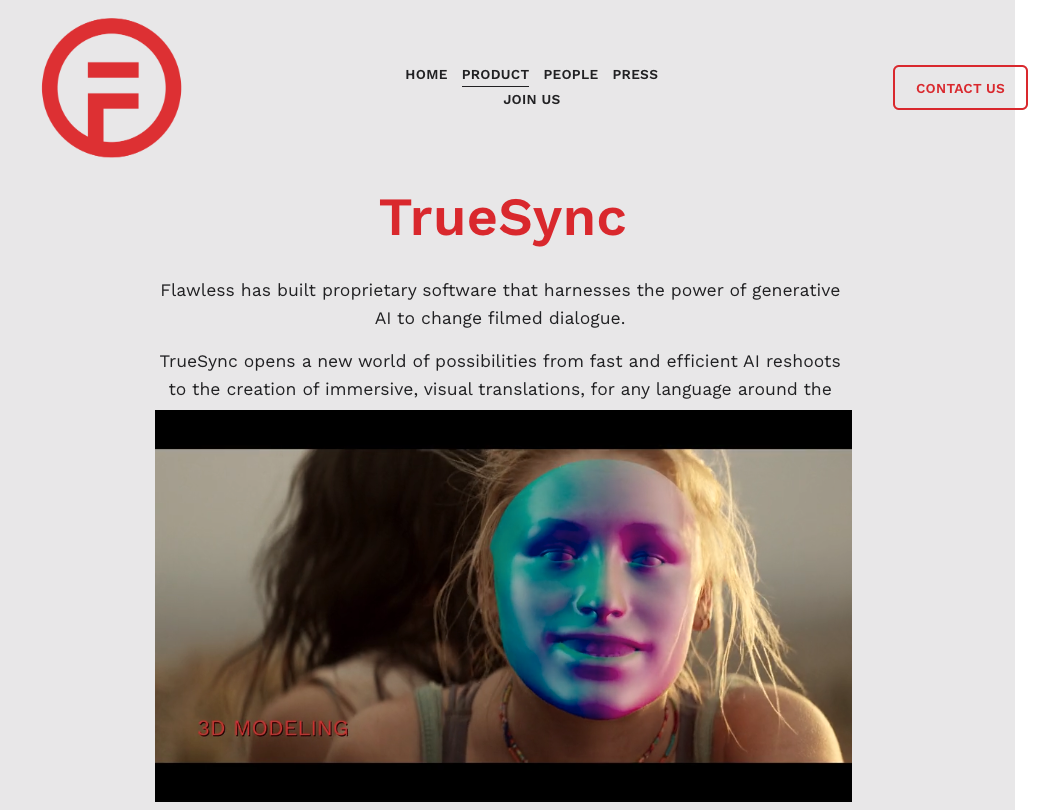
Flawless AI’s TrueSync is an innovative tool that is changing the landscape of filmed dialogue. This proprietary software harnesses the power of generative AI to seamlessly integrate dialogue changes into a scene, making it look and feel like the original. TrueSync can save filmmakers time and money by avoiding costly reshoots, while also providing a way to create immersive translations that can be enjoyed by audiences around the world.
TrueSync is exciting for the media industry because it opens up a world of possibilities for content creation. By making it possible to translate content into any language, TrueSync makes it easier for filmmakers and content creators to reach a wider audience. This is especially important in today’s global economy, where content is often distributed and consumed across borders.
For language learners, TrueSync is an empowering tool that can help them improve their language skills by providing them with high-quality visual translations. By watching films and TV shows with TrueSync’s visual translations, learners can immerse themselves in the language and pick up new words and phrases more quickly. This can be a game-changer for people who are trying to learn a new language.
In conclusion, TrueSync is an incredible tool that has the potential to transform the way we create and consume media. With its powerful AI technology, TrueSync is making it easier and more efficient to create high-quality content in any language. Whether you’re a filmmaker, content creator, or language learner, TrueSync is an innovative and exciting tool that has something to offer everyone.
#innovative#exciting#empowering#filmmakers#mediaindustry#languagelearners#AIreshoots#visualtranslations#proprietrarysoftware The Power of TrueSync: How Flawless AI’s Proprietary Software is Transforming Filmed Dialogue Flawless AI’s TrueSync is an innovative tool that is changing the landscape of filmed dialogue. This proprietary software harnesses the power of generative AI to seamlessly integrate dialogue changes into a scene, making it look and feel like the original. TrueSync can save filmmakers time and money by avoiding costly reshoots, while also providing a way to create immersive translations that can be enjoyed by audiences around the world. TrueSync is exciting for the media industry because it opens up a world of possibilities for content creation. By making it possible to translate content into any language, TrueSync makes it easier for filmmakers and content creators to reach a wider audience. This is especially important in today’s global economy, where content is often distributed and consumed across borders. For language learners, TrueSync is an empowering tool that can help them improve their language skills by providing them with high-quality visual translations. By watching films and TV shows with TrueSync’s visual translations, learners can immerse themselves in the language and pick up new words and phrases more quickly. This can be a game-changer for people who are trying to learn a new language. In conclusion, TrueSync is an incredible tool that has the potential to transform the way we create and consume media. With its powerful AI technology, TrueSync is making it easier and more efficient to create high-quality content in any language. Whether you’re a filmmaker, content creator, or language learner, TrueSync is an innovative and exciting tool that has something to offer everyone.
You’re inside the doctor’s surgery, sitting across from your physician. He breaks the news to you: you need brain surgery to remove a tumor. You’re faced with two options: a highly advanced AI robot surgeon or a human doctor named Dr. John Smith.
Option 1: The AI robot surgeon This option presents a fascinating, cutting-edge solution. The robot surgeon has been trained on every single brain operation that has ever been completed. It has access to vast amounts of data including video archives, interviews, books, patient results, and scans. The robot can work with a precision of 0.001 microns, make decisions in real-time, and boasts a success rate of 78.3%.
Option 2: Dr. John Smith Dr. John Smith is a human doctor who had a long day at work yesterday and is feeling stressed from his heavy workload. He has a success rate of 40.3%.
When faced with this decision, you must weigh the pros and cons of each option. On one hand, the AI robot surgeon is highly precise, has access to vast amounts of data, and has a high success rate. On the other hand, there’s something to be said for the human touch that Dr. John Smith can provide. Ultimately, the choice is yours.
In this scenario, the future of doctors is brought into sharp focus. Technology has the potential to revolutionize the medical field and make surgeries safer and more successful, but it also raises questions about the role of human doctors. The decision you make will depend on your personal values and priorities, but it’s clear that the future of brain surgery is going to be shaped by technology in a big way.
Google, known for its search engine, is reportedly concerned about the impact of OpenAI’s ChatGPT, a Q&A machine that uses natural language to respond to questions. ChatGPT’s user-friendly interface and fluid prose has led to speculation that it may end Google’s dominance in search. In response, Google has declared a “code red” and is focusing on AI with plans to release 20 AI-powered products this year, including a ChatGPT-like search bot. However, questions remain about the technology’s readiness for widespread use and whether it can be trusted for accurate information.
Google is one of the biggest companies on Earth. Google’s search engine is the front door to the internet. And according to recent reports, Google is scrambling. Late last year, OpenAI, an artificial intelligence company at the forefront of the field, released ChatGPT. Alongside Elon Musk’s Twitter acquisition and fallout from FTX’s crypto implosion, breathless chatter about ChatGPT and generative AI has been ubiquitous. The chatbot, which was born from an upgrade to OpenAI’s GPT-3 algorithm, is like a futuristic Q&A machine. Ask any question, and it responds in plain language. Sometimes it gets the facts straight. Sometimes not so much. Still, ChatGPT took the world by storm thanks to the fluidity of its prose, its simple interface, and a mainstream launch.
When a new technology hits public consciousness, people try to sort out its impact. Between debates about how bots like ChatGPT will impact everything from academics to journalism, not a few folks have suggested ChatGPT may end Google’s reign in search. Who wants to hunt down information fragmented across a list of web pages when you could get a coherent, seemingly authoritative, answer in an instant?
In December, The New York Times reported Google was taking the prospect seriously, with management declaring a “code red” internally. This week, as Google announced layoffs, CEO Sundar Pichai told employees the company will sharpen its focus on AI. The NYT also reported Google founders, Larry Page and Sergey Brin, are now involved in efforts to streamline development of AI products. The worry is that they’ve lost a step to the competition.
If true, it isn’t due to a lack of ability or vision. Google’s no slouch at AI. The technology here—a flavor of deep learning model called a transformer—was developed at Google in 2017. The company already has its own versions of all the flashy generative AI models, from images (Imagen) to text (LaMDA). Indeed, in 2021, Google researchers published a paper pondering how large language models (like ChatGPT) might radically upend search in the future. “What if we got rid of the notion of the index altogether and replaced it with a pre-trained model that efficiently and effectively encodes all of the information contained in the corpus?” Donald Metzler, a Google researcher, and coauthors wrote at the time. “What if the distinction between retrieval and ranking went away and instead there was a single response generation phase?” This should sound familiar.
Whereas smaller organizations opened access to their algorithms more aggressively, however, Google largely kept its work under wraps. Offering only small, tightly controlled demos to limited groups of people, it deemed the tech too risky and error-prone for wider release just yet. Damage to its brand and reputation was a chief concern.
Chat GPT Chat with AI Artificial Intelligence. Businessman using chatbot in computer smart intelligence Ai, artificial intelligence developed by OpenAI. Futuristic technology, robot in online system.
Now, sweating it out under the bright lights of ChatGPT, the company is planning to release some 20 AI-powered products later thisyear, according to the NYT. These will encompass all the top generative AI applications, like image, text, and code generation—and they’ll test a ChatGPT-like bot in search. But is the technology ready to go from splashy demo tested by millions to a crucial tool trusted by billions? In their 2021 paper, the Google researchers suggested an ideal chatbot search assistant would be authoritative, transparent, unbiased, accessible, and contain diverse perspectives. Acing each of those categories is still a stretch for even the most advanced large language models. Trust matters with search in particular. When it serves up a list of web pages today, Google can blame content creators for poor quality and vow to serve better results in the future. With an AI chatbot, it is the content creator, and if ChatGPT can’t get its facts straight, it may not be able to gain the trust of users, ultimately leading to its failure.